Olive Garden Italian Kitchen
- 3.5
- Rating
- 1.00M
- Installs
- Free
- Price
 Analysis by App-foxy
When I am deciding whether to eat out after a long day, the frustrating part is often not choosing the restaurant. It is figuring out whether a table is available, whether I have time to wait, and how to arrange food for everyone without making several separate calls. Olive Garden Italian Kitchen is built around that practical problem. It brings restaurant discovery, the wait-list process, ToGo ordering, and gift cards into one Food & Drink app from Darden Restaurants, Inc.
I tested it with that everyday situation in mind: a group wants Olive Garden, one person is already hungry, another cannot arrive immediately, and nobody wants to stand around guessing how long the evening will take. The app is free, aimed at Everyone, and has passed the point where it feels like an experimental restaurant companion. Its current version is 6.50.0, and it has more than a million installs. That reach matters because the app is most useful when it becomes part of a repeat routine rather than something opened once and forgotten.
From choosing a restaurant to getting food on the table
I find the most useful way to approach this section is to treat each choice as a different kind of commitment: a location choice sets the route, a wait-list entry shapes the arrival, and a ToGo order puts someone in charge of pickup. Thinking through those handoffs before tapping ahead helps me avoid rushing into the wrong workflow. From there, I can look more closely at what happens once the plan gets busy.
You May Also Like

 Blood Strike: 2.5 Anniversary
Blood Strike’s Loadouts Turn Every Drop Into a Tactical Gamble
A close look at Blood Strike’s custom loadouts: how fast access to signature weapons reshapes its battle royale rhythm, rewards preparation, and narrows the gap between fights.

 Pandora - Music & Podcasts
Pandora’s Music Is Easy to Start, but Harder to Recover
Pandora’s strength is its low-effort path from a seed to a station. Its weak spot is how much confidence it asks you to place in connection, setup, and quiet recovery.

 8 Ball Pool
 Is Built on Rivalries, Rematches, and Routine
A close look at the rivalries, rematches, shared routines, and unanswered safety questions that turn a quick pool match into a persistent mobile community.

 Samsung Music
’s Quiet Strength Is Playing What You Already Own
Its reach comes less from spectacle than from dependable access to a personal library. That simplicity is both the app’s strongest retention engine and its ceiling.

 AccuWeather: Weather Radar
AccuWeather Review: A Quick, Clear Forecast for Everyday Decisions
For everyday plans, the best forecast is the one you can understand quickly. AccuWeather makes rain timing, radar, and local conditions easy to act on, with a few trade-offs.

 Hill Climb Racing
Why Hill Climb Racing Still Turns Crashes Into One More Run
A tiny car, a bumpy hill and one more upgrade: Hill Climb Racing keeps resurfacing because its simple chaos makes every near-miss feel personal.
More From Our News Desk



Starting with the real problem
The first useful decision is whether I need a dine-in visit, a pickup order, or a gift card. Those paths sound similar, but they solve different problems. If I want to eat inside the restaurant and avoid an uncertain in-person wait, joining the Wait List is the relevant starting point. If I already know what I want and need to take it home, ToGo ordering is the better route. Gift cards serve a separate purpose and are handy when I want to prepare a present without making a restaurant visit.
I like that these needs are presented as parts of the same restaurant experience instead of forcing me to search for a separate ordering tool, a location page, and a gift-card service. The benefit is not that the app replaces every food app on my phone. Its benefit is narrower and more useful: it keeps Olive Garden-related tasks together.
That focus also tells me who should skip it. If I am comparing several Italian restaurants, looking for the cheapest nearby meal, or trying to order from independent restaurants in one place, a general delivery or restaurant-discovery service is more flexible. This app makes sense when Olive Garden is already the destination.
Finding the right location before making a commitment
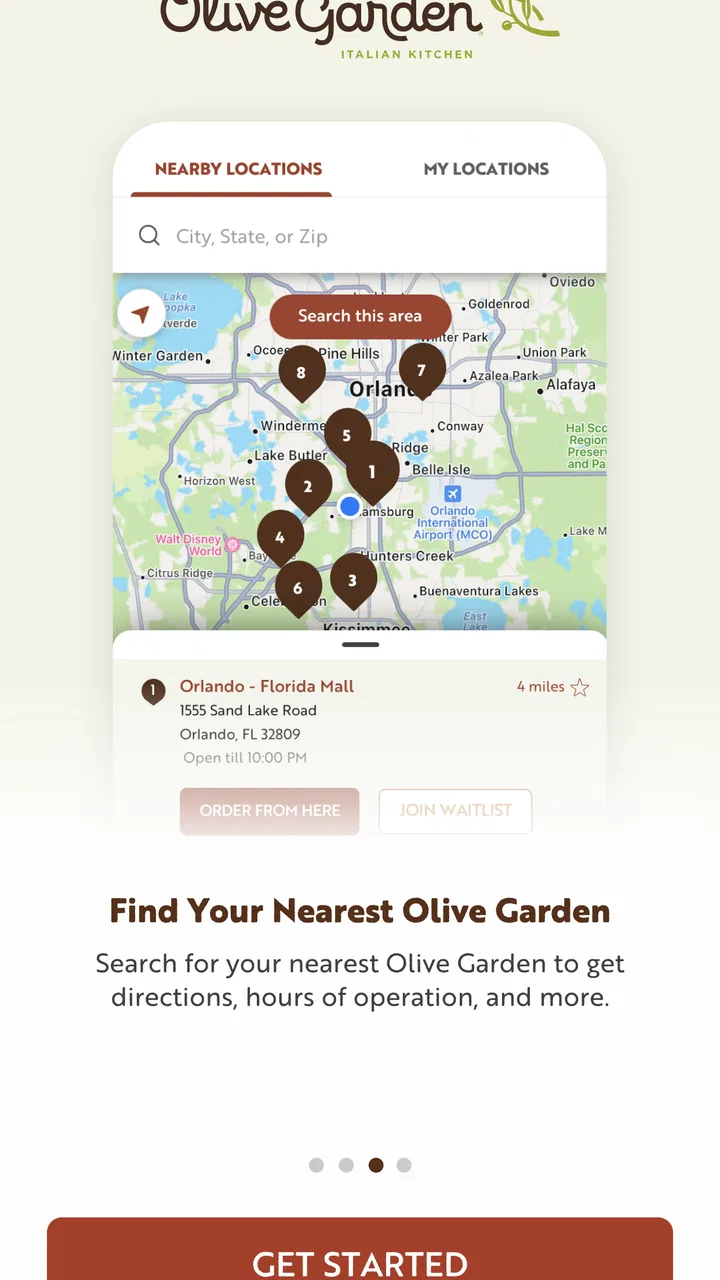
The location step deserves more attention than it usually gets. A restaurant app is only as helpful as the branch it connects me to, and the nearest location is not automatically the most convenient one. When I am arranging dinner for several people, I consider travel direction, who is collecting the order, and whether the selected restaurant makes sense for the rest of the evening.
My practical tip is to choose the location before spending time on the rest of the workflow. It reduces the chance of building a ToGo order around the wrong restaurant or joining a wait list for a branch that is awkward for the group. This is a small habit, but it prevents the most annoying kind of restaurant-app mistake: finishing the process and only then discovering that the selected location does not fit the plan.
The app is also more useful when I already know roughly where I want to eat. It is not a replacement for a map when I am exploring an unfamiliar area, and I would not open it expecting broad neighborhood recommendations. I use it as a direct route into Olive Garden’s own locations, not as a general-purpose local food guide.
Joining the Wait List instead of arriving blind
For dine-in plans, the Wait List is the feature that changes the workflow most. Rather than treating the restaurant visit as a single arrival event, I can begin the process before reaching the door. That is especially helpful when the group includes children, older relatives, or anyone who would rather wait somewhere else than in a busy restaurant entrance.
The important handoff happens here: the app starts the process, but the restaurant still completes the in-person experience. Joining the list does not turn the app into a remote dining room. I still need to arrive, keep track of the plan, and be ready for the restaurant’s next step. I see this as a time-management tool, not a guarantee that the evening will run exactly on schedule.
I would use the wait-list option when the group has already agreed on Olive Garden and is willing to travel there. I would not use it as a reason to choose a restaurant without checking whether the timing works. A wait list can reduce uncertainty, but it cannot remove the variables that come with a busy meal period, traffic, late arrivals, or a party that changes its size.
Building a ToGo order with fewer moving parts
When the plan changes from dining in to eating at home, the ToGo route is more direct. I can arrange the meal before leaving, which is useful when one person is collecting dinner for a household or when I want to avoid making a phone call while standing in a noisy place. The app’s value here is not just speed. It gives the order a clear starting point and keeps the pickup task connected to the selected Olive Garden location.
A useful workflow is to decide who owns the pickup before placing the order. If I am ordering for a family, I confirm the collection time and destination first, then build the meal. This sounds obvious, but it matters because a pickup order creates a handoff between the person using the app and the person carrying the food home. When those are different people, unclear timing can erase the convenience the app was supposed to provide.
I also prefer reviewing the order as a complete household plan rather than adding items one by one without thinking about the final result. The app can help me place the order, but it cannot decide whether the portions, preferences, and travel arrangements make sense for my group. That planning remains my responsibility.
Using gift cards as a separate workflow
The gift-card option is easy to overlook because it sits beside ordering and restaurant discovery, but it serves a different audience. I might use it when I want to give someone a meal without choosing their exact order. It is also more convenient than trying to coordinate a restaurant visit simply to purchase a gift.
Here the handoff is between the purchaser and the recipient. I need to make sure the gift card reaches the intended person and that they understand what it is for. The app helps with the purchase step, but the gift is not complete until that information is passed along. For a last-minute present, this can be more practical than buying something unrelated, although it is less personal if the recipient does not enjoy Olive Garden.
What the restaurant receives and what I still control
One of the most important distinctions is between app-controlled actions and restaurant-controlled outcomes. The app can put me on the digital path toward a table, a ToGo meal, or a gift card. The restaurant handles the physical service: seating, preparing food, and completing the pickup experience. That division explains both the convenience and the limits.
In my experience, this makes the app feel more like a coordination layer than a full restaurant replacement. It reduces the number of steps I have to remember, but it does not remove the need to read the confirmation carefully, arrive at the selected location, or communicate with the people involved in the plan.
This is also why I would not treat the app as a substitute for calling the restaurant in every unusual situation. A straightforward wait-list entry or ToGo order fits the app well. A complicated request, a changing group, or a situation requiring a detailed conversation may be better handled directly with restaurant staff. The app is strongest when the task is structured.
A realistic evening from input to outcome
Imagine that I finish work and three relatives want dinner, but nobody wants to spend the first part of the evening waiting at the restaurant. I open the app, select the Olive Garden location that fits our route, and choose the dine-in path. I join the Wait List, tell the group where we are in the process, and travel while everyone gets ready.
That first handoff is from me to the restaurant: the app communicates the request, but I remain responsible for arriving. The second handoff is from me to the group: everyone needs the same location and a realistic understanding of the plan. If the timing works, the result is a smoother arrival because the waiting process began before we reached the restaurant.
On another evening, I might be taking dinner home. I select the appropriate location, build a ToGo order, and make sure the person collecting it knows what to do. The handoff then moves from the app to the restaurant and from the restaurant to the pickup person. Once the meal reaches the table at home, the app has completed its role. It has not cooked dinner or managed the household, but it has reduced the coordination between those points.
That is the clearest way to understand the product: input is my restaurant choice and dining plan; the middle is location selection and the chosen service; the outcome is either a better-organized arrival, a pickup meal, or a gift-card purchase.
Where the flow can break
The app’s main weakness is that a clean digital flow cannot guarantee a clean real-world result. A wait-list process may still be affected by restaurant capacity and arrival timing. A ToGo order still depends on the pickup handoff. A selected location can still be inconvenient if I chose it too quickly. These are not reasons to avoid the app, but they are reasons to keep expectations realistic.
Another limitation is its narrow usefulness. The app is not designed to help me compare Olive Garden with other restaurants, combine orders from different businesses, or search the whole area for a better option. If I am undecided about cuisine or want delivery choices across many restaurants, I would reach for a broader service instead.
I also find that restaurant apps can encourage me to focus on completing the digital steps rather than checking the practical details. My best safeguard is a final pause before submitting anything: confirm the location, the service type, the pickup responsibility, and the plan for the people joining me. That short review is more valuable than rushing through the screens.
How it compares with calling or using a general food app
Calling the restaurant can be better when I need a conversation, especially for an unusual situation or a plan that keeps changing. The phone is less convenient for browsing and repeating routine orders, but it gives me a direct human handoff. I see the Olive Garden app as the better choice for predictable tasks and the phone as the better choice for exceptions.
General food apps win when I want variety, delivery comparisons, or one checkout covering multiple restaurants. They may also be more familiar if my household already uses them for every meal. Olive Garden’s app wins on directness: I am not searching through unrelated listings or wondering whether I am using the correct restaurant channel.
The trade-off is simple. Broader services offer choice; this app offers a focused path to one restaurant brand. I would install it if Olive Garden is a recurring option in my routine. I would skip it if my visits are rare and I already have a satisfactory way to handle restaurant searches and orders.
Who gets the most value from it
Families, regular Olive Garden customers, and people who often coordinate meals for several diners are the strongest audience. The Wait List can help someone plan around a busy schedule, while ToGo ordering can make a pickup meal easier to organize. Gift cards add value for people who regularly give restaurant-based presents.
It is also useful for anyone who dislikes making routine phone calls. The app gives those users a more structured way to begin the restaurant process. I would still encourage them to keep an eye on the final details, because avoiding a call does not mean avoiding responsibility for the plan.
People who should think twice are occasional visitors, restaurant explorers, and diners who need broad delivery coverage. For them, the extra app may not earn its place on the phone. The decision depends less on the app’s price—it is free—and more on how often Olive Garden fits their actual life.
My verdict after using the complete workflow
Olive Garden Italian Kitchen is a practical companion for a specific restaurant relationship. It does not try to be a universal food marketplace, and that restraint is part of its appeal. I can move from location choice to a wait-list plan, ToGo pickup, or gift-card task without switching between unrelated tools.
The app currently holds a 3.6 average from around 17 thousand ratings, which feels consistent with a useful but purpose-built experience: convenient when the workflow matches my needs, less compelling when I want flexibility beyond Olive Garden. It has been available since March 29, 2016, and its Everyone rating makes it approachable for a broad household audience. The developer is Darden Restaurants, Inc., and the app requires iOS 11 or later.
My recommendation is conditional but positive: install it if Olive Garden is a regular choice and you value organized wait-list or ToGo planning. Before each important order, verify the location and decide who handles the next handoff. If you need restaurant variety, delivery comparisons, or detailed personal assistance, use a broader food service or contact the restaurant directly. For the right situation, this free app turns a familiar restaurant visit into a more manageable sequence from decision to meal.
FAQs for Olive Garden Italian Kitchen
01What platforms is the Olive Garden Italian Kitchen app available on?
The Olive Garden Italian Kitchen app is available for both Android and iOS devices. You can download it from the Google Play Store for Android or the Apple App Store for iOS. Ensure your device meets the system requirements for smooth operation.
02Can I make a reservation through the Olive Garden app?
Yes, the Olive Garden app allows you to easily make reservations at any participating location. Simply select your desired restaurant, choose your preferred date and time, and confirm your booking. It's a convenient way to ensure your table is ready upon arrival.
03Are there any exclusive deals or offers available on the app?
The Olive Garden app often features exclusive deals and offers for users. These can include discounts, special menu items, or loyalty rewards. Be sure to check the app regularly to take advantage of these promotions and enhance your dining experience.
04Does the Olive Garden app offer a menu preview?
Absolutely. The Olive Garden app provides a comprehensive preview of the menu, including detailed descriptions and nutritional information for each dish. This feature allows you to browse and decide on your meal choices before visiting the restaurant, ensuring a more efficient dining experience.
05Is it possible to order takeout or delivery through the app?
Yes, the Olive Garden app allows you to conveniently order takeout or delivery. You can browse the menu, customize your order, and pay directly through the app. Whether you're dining in or taking out, the app streamlines the process for a hassle-free experience.
Pros
- User-friendly interface for easy navigation.
- Extensive menu with detailed descriptions.
- Offers exclusive discounts and promotions.
- Seamless integration with online reservations.
- Push notifications for order updates.
Cons
- Limited customization options for dishes.
- Occasional slow loading times.
- Requires account creation for full features.
- In-app purchases can be pricey.
- No offline menu access available.

Olive Garden Italian Kitchen
Gallery